
The science behind what you sleep in
Not all wool is the same. Fiber type, micron count, staple length, and treatment determine whether a wool product performs — or merely feels natural. Here is everything we know about the fiber we chose, and why.
The major wool types explained
Wool comes from several animals and breeds, each with distinct characteristics. Understanding the differences explains why the same label — "wool" — can mean an ultra-fine cashmere sweater or a stiff carpet underlay.
The finest animal fiber commercially available. Combed from the undercoat of cashmere goats, it is extraordinarily soft and lightweight — but also the most fragile, prone to pilling, and expensive. Supply is limited by nature.
- High-end fashion & knitwear
- Luxury scarves & accessories
- Not suitable as bedding fill — too delicate
The gold standard of sheep wool. Merino's extreme softness makes it ideal for next-to-skin garments. However, its short staple length (40–90mm, but often processed shorter) means it is prone to pilling when used as a fill under sustained compression.
- Performance activewear & base layers
- Luxury blankets & throws
- Fine knitwear & hosiery
Sourced from Australian Merino sheep — bred to deliver the natural benefits of Merino wool with the structural resilience needed for bedding. At 31–32 μm, fine enough to be comfortable against skin, yet strong enough to maintain crimp, loft, and shape under the weight and heat of sleep.
- Bedding fill (toppers, comforters)
- Mattress protectors
- Mid-weight blankets & throws
A New Zealand / Australia crossbreed known for its versatility. Used widely in hand-spinning, felt making, and mid-range textiles. Slightly finer than our bedding wool, but with less natural crimp, which reduces loft retention in thick fills.
- Hand-spinning & craft textiles
- Mid-grade blankets
- Felting
Not sheep wool but often compared to it. Alpaca fiber is hollow, making it exceptionally light and warm. It contains no lanolin (hypoallergenic), but lacks the natural crimp of sheep wool — which means less loft and bounce-back in bedding applications.
- Luxury knitwear & scarves
- Lightweight blankets
- Some specialist bedding fills
Coarse wools are valued for their durability and abrasion resistance rather than softness. They feel prickly against bare skin and are unsuitable for any textile that comes into contact with the body. Their strength and stiffness make them ideal for structural applications.
- Carpets & rugs
- Upholstery & mattress padding
- Industrial insulation
The sweet spot for sleep
Bedding operates under a unique set of demands. It must be soft enough to feel pleasant against skin, yet structurally robust enough to hold its loft and shape through years of nightly compression, washing, and temperature cycling.
Fibers below 25 μm — cashmere, fine merino — are extraordinarily soft, but their short staple and delicate structure cause them to mat and pill under sustained compression. Over months of use, a too-fine fill collapses.
Fibers above 33 μm become perceptibly coarse and are often processed for industrial or hard-wear use. There is a window — roughly 28–34 μm — where softness and structural performance intersect. Our wool sits at 31–32 μm: deliberately chosen, not coincidental.
Micron scale — where our wool sits
← finer coarser →
How we choose every batch
Selecting wool for bedding is not a one-time decision. Fiber quality varies season to season, farm to farm. Our sourcing process is built around consistency — because a product that performs in year one should perform exactly the same in year five.
"We don't buy wool by specification alone. We test it, feel it, and reject batches that don't meet the standard — even when that means a delay in production."
-
01
Farm Selection
We source exclusively from certified Australian farms with documented animal welfare standards. Each farm is audited annually for flock health, pasture management, and ethical shearing practices.
-
02
Fiber Testing
Each incoming batch is independently lab-tested for micron count, staple length, vegetable matter content, and tensile strength. Any batch outside our 31–32 μm / 50–60mm window is returned.
-
03
Wash Treatment (Protector only)
The wool designated for our Mattress Protector undergoes a chlorine-free Hercosett washability treatment. This is done in controlled batches to verify that the process does not compromise micron or staple integrity.
-
04
Fill Density Check
Before a finished product leaves the facility, fill weight and distribution are measured against our specification. Uneven fill — a common quality failure in wool bedding — is grounds for rejection.
Why Australian Wool?
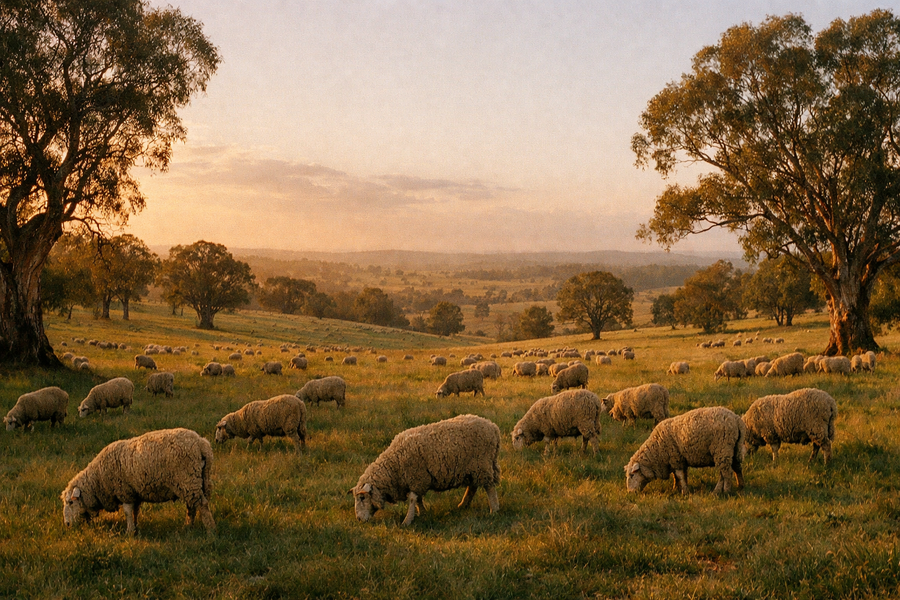
Australia produces some of the world's finest Merino wool — raised on vast open pastures under a temperate climate that encourages slow, consistent fleece growth. The result is a fiber that is naturally resilient, breathable, and remarkably soft.
Our Merino wool is sourced exclusively from Australian farms that meet strict animal-welfare and traceability standards, ensuring that every product you sleep under tells an honest story from pasture to pillow.
- Raised on open pastures — no factory farming
- Traceable supply chain from farm to finished product
- Natural temperature regulation year-round
- Biodegradable & renewable — a sustainable choice
Micron Count: 31–32 μm
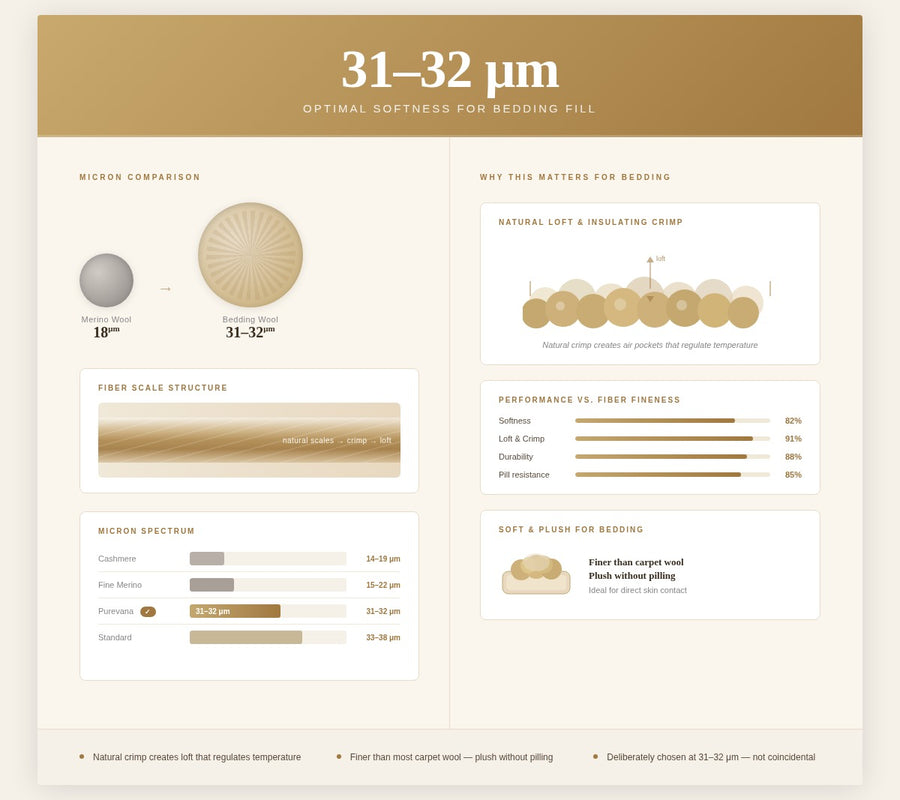
Micron (μm) is the unit used to measure the diameter of a single wool fiber. The lower the micron, the finer — and softer — the fiber. Fashion fibers like cashmere (14–19 μm) or fine merino (15–22 μm) score beautifully in softness tests, but collapse under the sustained compression and heat of a sleeping body. Our Australian Merino wool sits at 31–32 μm: the ideal balance point for performance bedding.
Fine enough to feel soft and comfortable against the skin, yet coarse enough to create the natural crimp and loft that traps warm air and provides insulating depth — the quality that makes wool bedding genuinely superior to synthetics for year-round sleep comfort.
- 31–32 μm — optimal softness for bedding fill
- Natural crimp creates loft that regulates temperature
- Finer than most carpet wool; plush without pilling
Fiber Length: 50–60 mm
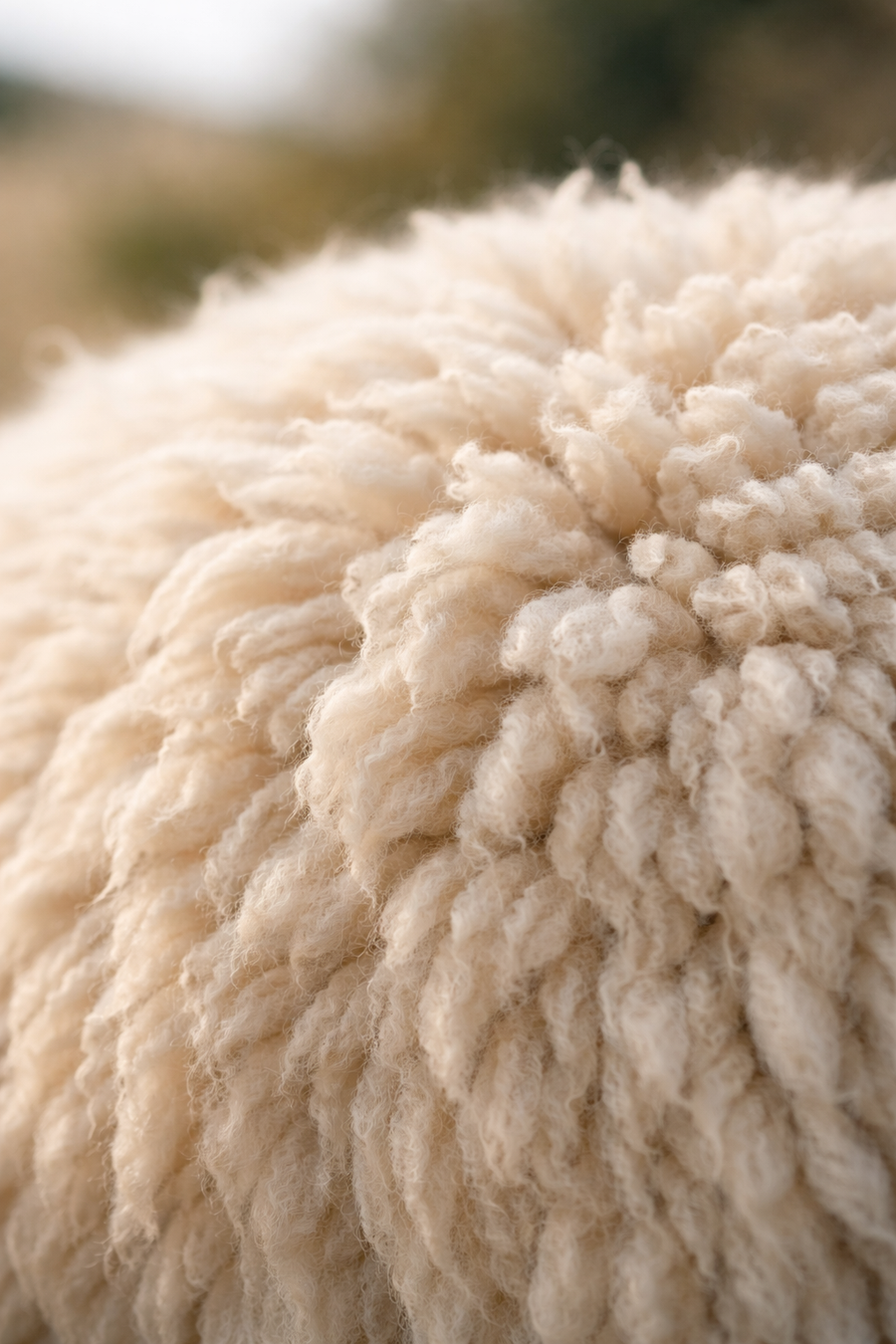
Staple length refers to the length of a single wool fiber — measuring from root to tip. It is one of the key indicators of quality and durability in wool products. At 50–60 mm, our fiber is classified as a medium-long staple, which brings two important advantages.
First, longer fibers are harder to pull out of the fill, meaning the wool retains its loft and distribution over time. Second, longer fibers resist matting and pilling far better than short-staple alternatives — the reason a Purevana product feels as full after five years as it did on day one.
- 50–60 mm — medium-long staple, superior durability
- Resists matting, clumping, and uneven distribution
- Longer fibers = stronger product over years of use
Fiber Length: 50–60 mm
Why fiber length determines longevity
How we clean
and prepare our wool
Every gram of wool that goes into a PUREVANA product passes through a rigorous seven-step process — designed to preserve the fiber's natural qualities while removing everything that shouldn't be there.
Freshly sheared wool is inspected and cleared of grass, dirt, and stones before any washing begins — reducing the burden on every step that follows.
The wool is soaked in warm water (40–60°C) with gentle degreasers to loosen lanolin and surface contaminants, followed by careful agitation to lift impurities from the fiber.
The wool is rinsed several times in clean warm water to remove all traces of detergent and loosened dirt — without the heat that would damage the fiber structure.
Lanolin — wool's natural protective grease — is carefully extracted. Done with precision: too little left and the fiber dries out, too much and quality suffers. Multiple passes ensure it's done right.
Excess water is removed by centrifugal dryer, then the wool is air-dried in a well-ventilated space — away from direct sunlight to protect the fiber's natural integrity.
The dried wool is carded to remove remaining fine impurities and align the fibers. This step gives the wool its characteristic softness and prepares it for crafting into bedding.
Every batch undergoes a thorough final check. Only wool that meets our cleanliness and quality standards moves forward to production — no exceptions.
This process takes place at our OEKO-TEX® certified manufacturing facility — independently verified to meet the most rigorous textile safety standards in the world.
Two types of wool, one standard of quality
Washable Australian Merino Wool
Used in: Mattress Protector
Our Mattress Protector uses wool that has been treated to withstand machine washing without felting or shrinking. A special chlorine-free Hercosett process alters the microscopic scales on each fiber, preventing them from interlocking when agitated in water — so you get the hygiene of a washable product without sacrificing the performance of natural wool.
Used in → Mattress Protector
Natural Australian Merino Wool
Used in: Topper & Comforter
The wool in our Topper and Comforter is left in its natural, untreated state. The intact fiber scales are the very thing that gives wool its extraordinary thermal properties — the tiny overlapping scales create millions of tiny air pockets that insulate in winter and wick moisture in summer. Treating this wool for washability would compromise that performance.
Used in → Topper · Comforter